In this guide9 sections
- Start by reading the invitation closely
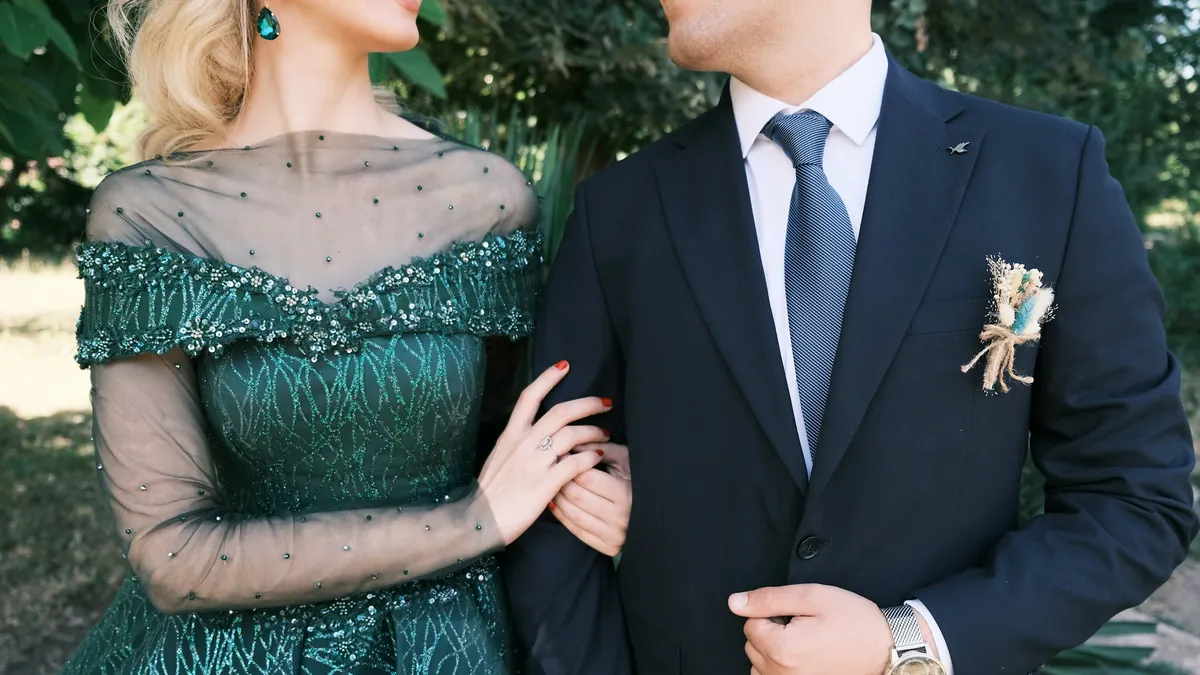
- Dress codes, one by one
- Civil, church, day or night
- Colors to avoid
- How to dress for Lima’s weather by season
- Shoes and accessories
- Getting married? How to put the dress code on your invitation
- Last-minute questions
- Your invitation, dress code and registry together with parati
“Formal,” “cocktail,” “black tie”… the invitation gives you one word and it’s on you to turn it into an outfit. This guide explains what each dress code means, how it shifts with the type of ceremony and the time of day, which colors to steer clear of and how to dress for Lima’s weather in each season. And if you’re the one getting married, the last section shows how to word the dress code so nobody has to text you about it.
Start by reading the invitation closely
Before you open your closet, gather the clues:
- The dress code, if there is one.
- The time. A noon ceremony and a party that starts at 8 p.m. call for different things.
- The venue. A church, a ballroom, a country house with a lawn or a beach changes the fabric and, above all, the shoes.
- The type of ceremony: civil, religious or both.
If you’re still unsure, ask the couple or someone close to them. A quick message beats showing up in the wrong thing.
Dress codes, one by one
These are the most common interpretations. They aren’t official rules, and they vary a little depending on who’s writing them, so treat them as a starting point.
| Dress code | Men | Women |
|---|---|---|
| Black tie (etiqueta in Peru) | Tuxedo with a bow tie or, if you don’t own one, a sharp dark suit | Floor-length evening gown |
| Formal | Dark suit and tie | Long gown or an elegant cocktail dress |
| Cocktail | Suit and tie; lighter colors work for daytime | Knee-length or midi dress, or a dressy two-piece |
| Semi-formal | Suit without a tie, or a blazer with dress pants | Midi dress, or a skirt or dress pants with a nice top |
| Casual or dressy casual | Dress pants or chinos with a button-down, jacket optional | Simple dress, or pants with a blouse |
| Beach | Linen or cotton, long-sleeve shirt, no tie | Light, breezy dress in pale colors or prints |
“Etiqueta rigurosa” doesn’t always mean the same thing
On Peruvian invitations you may see etiqueta rigurosa (“strict formal”). Some people use it for white tie (tailcoats), the most formal code there is; others use it as another way of saying tuxedo. If yours says it, ask. In practice, it almost always means a tux for men and a floor-length gown for women.
If the invitation doesn’t say
Go by the time and place. An evening wedding in a ballroom usually calls for at least formal. A daytime wedding at a country house leaves room for semi-formal. If you’re torn between two options, pick the dressier one: nobody feels bad about being a little overdressed.
Civil, church, day or night
Civil ceremony
Civil weddings tend to be shorter and more intimate, and they’re often held during the day, either at the municipalidad (city hall) or at the party venue. Our guide to the civil wedding in Lima shows that the municipality offers both options. If there’s no big party afterward, cocktail or semi-formal works well: a suit, a midi dress, light colors for daytime. At a community civil wedding the district sets the hour and the ceremony is shared with dozens of couples, so ask the couple how formal they want the photos.
Church ceremony
A church calls for a bit more restraint. For the ceremony itself, skip plunging necklines and bare shoulders, or bring a wrap you can take off at the reception. If the ceremony and the reception are on the same day, dress for whichever is more formal.
Day or night
- Daytime: lighter fabrics, pale or pastel colors, knee-length or midi dresses, suits in light gray, beige or blue.
- Evening: heavier fabrics, dark or rich colors, long gowns, dark suits. Sparkle and sequins look their best at night.
Colors to avoid
- White, ivory and cream. Those belong to the bride, unless the couple specifically asks everyone to wear white.
- Near-white shades with lace or tulle: even if they’re technically beige, they can read as white in photos.
- The bridesmaids’ color, if the couple has shared it. It’s not a faux pas, but in photos you’ll look like part of the wedding party.
- Black, with nuance: it’s widely worn at evening weddings these days. If the family is very traditional or the ceremony is during the day, add some color with your accessories.
If you have a role in the ceremony, ask about the color too: several Peruvian wedding traditions get photographed every single time—the arras, the lazo, the cake ribbons—and you’re in a good number of them.
How to dress for Lima’s weather by season
Lima’s weather swings more between summer and winter than many visitors expect, and a party that runs into the early morning goes through several temperatures. Keep in mind that Peru is in the Southern Hemisphere, so the seasons are the reverse of the US.
| Season | What to expect | What to bring |
|---|---|---|
| Summer (December to March) | For summer 2026, SENAMHI (Peru’s national weather service) forecast 20.4–27.5 °C (69–82 °F) in districts near the ocean and 19.2–29.2 °C (67–85 °F) in inland areas such as La Molina, Ate or San Juan de Lurigancho, with highs near 30 °C (86 °F) in February and March | Breathable fabrics (linen, cotton, silk), lightweight suits, sunscreen for outdoor ceremonies |
| Winter (June to September) | In August, one of the coldest months, typical highs are 19–21 °C (66–70 °F) and lows 14–15 °C (57–59 °F), with overcast skies, high humidity, fog and garúa (a very fine drizzle) | A wrap, a coat or a jacket that matches your outfit, sheer tights, shoes that can handle a damp lawn |
| Fall and spring | Transitional months | A light layer for the evening, even if the day is mild |
The summer figures come from SENAMHI’s forecast for summer 2026, as reported by Infobae on December 20, 2025 (in Spanish). The winter figures are SENAMHI’s typical August conditions, as reported by Infobae in August 2026 (in Spanish). Both checked on September 17, 2026; Fahrenheit conversions are ours. Every year is different, so check the SENAMHI forecast the week of the wedding, especially if it’s outside Lima.
Shoes and accessories
- Grass: block heels or platforms; stilettos sink. For men, soles with some grip.
- Sand: flat or wedge sandals. Many beach weddings let guests go barefoot at the party, so bring a backup pair.
- For dancing: comfortable shoes in your bag will save your night, especially during the hora loca (“crazy hour,” the late-night stretch of Peruvian weddings with costumes, noisemakers and nonstop dancing).
- A small bag: just enough for your phone, the gift envelope if you bring one and a few touch-up essentials.
Still deciding on a gift? Our guide on how much money to give at a wedding helps you settle on an amount.
Getting married? How to put the dress code on your invitation
A clear dress code saves you dozens of messages. A few pointers:
- Use a familiar term (formal, cocktail, beach) and, if it could be misread, add a line that explains it.
- Mention the ground. “The ceremony will be on the lawn” changes everyone’s shoe choice.
- If there’s a color you’d rather guests skip, say so kindly.
- If the party is outdoors in winter, suggest bringing a coat.
- Put it next to the date and venue, where guests will look for it.
A few ways to word it:
- “Dress code: formal. The ceremony will be in the garden, so we recommend block heels.”
- “Cocktail attire. We’d love for white to be the bride’s color only. Thank you!”
- “Beach chic: breezy fabrics, no ties and plenty of energy for dancing in the sand.”
You’ll find more ideas in our guide to the digital wedding invitation. And if you’re already thinking about who will stand with you at the altar, read about wedding sponsors, or padrinos.
Last-minute questions
Can I wear black to a wedding?
These days yes, especially at evening weddings, where it’s widely worn. The exception is a very traditional family or a daytime ceremony: there it helps to break it up with some color in your accessories. What you always skip is white, ivory and cream, plus near-white shades with lace or tulle, which read as white in photos.
What do I wear to a wedding in Lima in winter?
Layers. In August, one of the coldest months, typical highs are 19–21 °C (66–70 °F) and lows 14–15 °C (57–59 °F), with overcast skies, high humidity, fog and garúa, a very fine drizzle. Bring a wrap, a coat or a jacket that matches, sheer tights and shoes that can handle a damp lawn, and check the SENAMHI forecast the week of the wedding.
What shoes work if the ceremony is on grass?
Block heels or platforms: stilettos sink. For men, soles with some grip. On sand, flat or wedge sandals plus a backup pair, since many beach weddings let guests go barefoot at the party. And keep a comfortable pair in your bag: they will save your night once the hora loca starts.
Do I dress the same for the civil ceremony and the party?
Not always. Civil weddings tend to be shorter and held during the day, either at city hall or at the party venue, and if there’s no reception afterward, cocktail or semi-formal is plenty: a suit, a midi dress, light colors. If the ceremony and the reception fall on the same day, dress for whichever is more formal.
Your invitation, dress code and registry together with parati
With parati, the invitation and the gift registry live on one link that you share on WhatsApp, so your guests have the dress code, address and time at hand every time they open it.
- Guests RSVP and give gifts from their phone, without creating an account, paying by card or Yape (a popular mobile payment app in Peru).
- You see who RSVP’d and who gave what.
- Gifts for every budget. A big gift can be split into parts so several guests can share it, and El Sueño (The Dream) is a big gift with a goal and a minimum contribution that you set.