In this guide10 sections
- What a lluvia de sobres is
- What it means when it’s on the invitation
- 7 lines to put a lluvia de sobres on the invitation
- How to ask for one without making it awkward
- How much to give at a lluvia de sobres
- Where it comes from: la palpa and el ayni
- What guests usually want to know
- Running it well on the day
- The online version
- How to do it with parati
If you’ve been invited to a wedding in Peru and the invitation mentions a lluvia de sobres, here’s what it means: literally “a shower of envelopes,” it’s the custom of giving cash in a sealed envelope on the day of the party instead of bringing a gift. There’s no exact equivalent in English—“money envelope” or “cash gift” comes closest—and in Peru it sits on top of a much older tradition of giving money at weddings. It has nothing to do with the chain schemes that ask you to send money to strangers with the promise of getting more back: that’s a pyramid scheme, even when it borrows the same name.
What a lluvia de sobres is
Instead of bringing an object, each guest brings cash in an envelope and hands it over at the celebration. Hosts announce it on the invitation so that nobody turns up with something they already own, and so that guests who would rather give money don’t feel they’re breaking an unwritten rule.
It isn’t only for weddings. You’ll see it at quinceañeras (a girl’s fifteenth-birthday celebration), birthdays, christenings and baby showers, and the phrase is used across much of Latin America. At a quinceañera the request goes out with the invitation, two or three months before the party, following the order laid out in how to plan a quinceañera step by step.
What it means when it’s on the invitation
Two things, and they go together:
- They’d rather have money than things. Usually because their home is already set up, because they’re moving, or because they’re saving for something specific.
- There’s no registry to follow. You decide the amount; nobody is going to tell you what it should be.
What it does not mean: that there’s a going rate, that the envelope is compulsory, or that a guest who shows up with a thoughtful gift has made a mistake.
7 lines to put a lluvia de sobres on the invitation
They go at the end of the invitation or in the gifts section, never in the middle of it. Adapt these to your tone and to what you’re saving for. If none of them fits, there are sixty more, sorted by celebration, in cash gift wording for invitations.
For a wedding
- “Having you with us is the best gift of all. If you’d also like to give us something, there will be a lluvia de sobres.”
- “We already have a home and everything that fits in it. If you’d like to give us a gift, an envelope brings us closer to the trip we’ve been dreaming about.”
- “Envelope or no envelope, what we want most is to see you on the dance floor.”
For a quinceañera
- “The best gift is being there with [name] on her night. If you’d like to give her something, there will be a lluvia de sobres.”
- “We’re saving for her school trip. If you’d like to be part of it, an envelope helps more than anything.”
For a birthday, a christening or a baby shower
- “No gifts, please. If you’d like to give something, there will be a lluvia de sobres.”
- “We have almost everything ready for the baby. If you’d rather, you can leave us an envelope.”
There’s more wording, and where to put it, in our guides on how to ask for money as a wedding gift and on the digital wedding invitation.
How to ask for one without making it awkward
Hardly anyone minds giving money. What grates is how it’s asked for. Five rules that work:
- Make it an option, not a condition. “If you’d like to give us something” leaves the door open; “gifts are cash only” shuts it.
- Say what it’s for. The trip, the down payment, the quinceañera’s school trip. A concrete goal turns money into a gift with a story.
- No amounts. No minimum, no suggested figure, no “starting at.” Anyone who can’t match the number may decide not to come.
- Put it in the right place. The invitation is about the celebration; the request belongs at the end or in the gifts section, never in the middle of the announcement.
- Ask once. If it’s on the invitation, don’t bring it up again over WhatsApp.
How much to give at a lluvia de sobres
There’s no reference figure. As of 9 October 2026 we found no published survey or study measuring how much goes into an envelope in Peru, so you won’t read an average here—be wary of the ones that circulate without saying where or when they were measured. What does work is deciding with four questions, in this order:
- How close are you to the hosts? It weighs the most. The closer you are, the more it makes sense to aim for the top of what you can give.
- Are you going alone or with others? If your partner or children are invited, it’s usually one envelope from all of you.
- What does it cost you to get there? If the party is in another city, you’re already paying for travel and a place to stay, and it’s fair for that to count.
- What does your month allow? Set a ceiling before thinking about what’s “expected.” An envelope that puts you into debt does nobody any good.
Your plate is a hint, not a rule. There’s an idea that the envelope should cover what your meal costs. But you don’t know what it costs, the hosts chose the venue, and it ties your gift to someone else’s budget instead of yours.
Local custom counts too. At a lluvia de sobres the envelope is sealed and nobody sees what you gave. At a palpa in the Mantaro valley, explained below, gifts may be handed over in front of everyone, and each family’s custom carries more weight.
If the online version has a minimum set by the hosts, that’s the floor; the rest is up to you. There’s a worked example for setting your own range in how much money to give at a wedding.
Where it comes from: la palpa and el ayni
Giving money at a Peruvian wedding didn’t arrive with the lluvia de sobres. In the Mantaro valley, in the central Andes, there’s the matrimonio con palpa, which Peru’s state news agency Andina describes as “a hundred-year-old tradition” in which the two families compete “to see which of them gives the best gifts.” Presents are handed over in the middle of the reception hall and can arrive “in the form of hard cash,” or as a car, a plot of land or a house (Andina, Nov. 5, 2014, in Spanish, consulted on September 17, 2026).
Reporting on another palpa in Huancayo, the same agency writes that “the money given in a sealed, secret envelope—and sometimes openly, showing what was inside—was the shoulder needed to build not a house, but the couple’s future,” and explains it as a modern version of ayni, the Andean principle of reciprocity: I help you today, you help me at your own wedding tomorrow (Andina, Sept. 23, 2016, in Spanish, consulted on September 17, 2026).
That’s the best way to read the custom: it isn’t a fundraiser, it’s a contribution that comes back around when it’s the other family’s turn to celebrate.
The name itself has been argued over for decades. When the practice caught on in Colombia, the newspaper El Tiempo ran a piece in which an etiquette expert pushed back—“a gift can never be an imposition, because it loses all its meaning”—and quoted an Opinómetro poll for the paper in which 47% of respondents called it tasteless and only 27% approved of it (El Tiempo, Nov. 2, 2002, in Spanish, consulted on September 17, 2026). Those are figures from another country and more than twenty years ago, so don’t read them as a measure of today—but they explain why the wording still matters.
What guests usually want to know
Do I write my name on the envelope?
Always. It’s the single most useful thing in this guide: an unsigned envelope can’t be thanked. Write your name on the outside, and if you’re coming with a partner or your family, write everyone’s name—in that case one envelope from all of you is the norm.
Can I bring an actual gift instead?
Of course. A lluvia de sobres tells you what the hosts prefer, not what’s forbidden. If you bring an object, make it something you know they need.
What if I can’t give anything?
Go anyway. RSVP’ing on time and being there is worth more than an envelope you can’t afford.
Running it well on the day
If you’re the one asking for it, these details save the usual headaches:
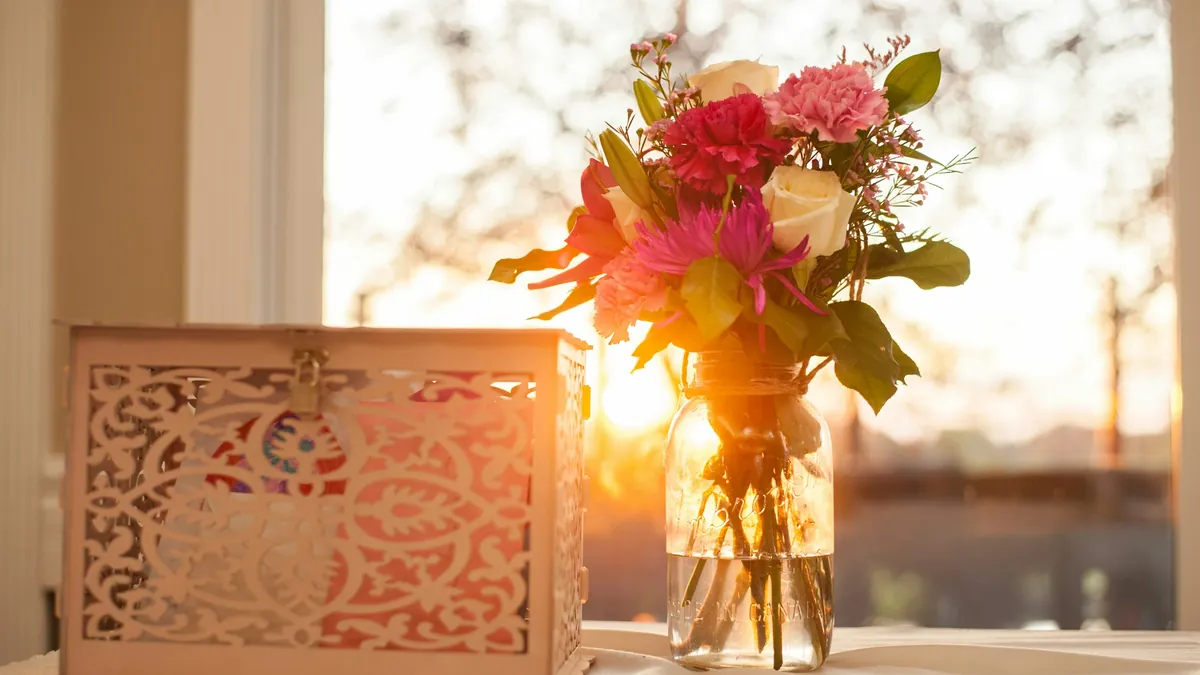
- A visible place to leave envelopes: a decorated chest, a post box or a card box on the reception table, with someone you trust keeping an eye on it.
- Someone responsible who isn’t you: a padrino (wedding sponsor), a sibling, anyone who will take the box home at the end of the night instead of leaving it at the venue.
- Don’t open them at the party. Count them the next day, calmly.
- Write down who gave what as you open them, on the same guest list. It’s the only way to thank people one by one, and by the next morning nobody remembers.
- Have a plan B for the guest who arrives with no cash: a link they can give from on their phone solves that moment at the door.
The online version
More and more guests carry no cash, and more and more couples live far from half of their guest list. Hence the digital version of the custom: instead of a physical envelope, the contribution is made from a phone, through a link, before or during the party.
What you gain:
- Nobody has to stop at an ATM or carry cash to the venue.
- It can arrive before the day. Guests who can’t come still take part.
- Every contribution comes with a name, so thanking people stops being a memory exercise.
- There’s no cash box sitting around at the party.
What you lose: the gesture of handing the envelope over. That’s why many celebrations keep both—the box at reception and the link on the invitation.
How to do it with parati
With parati for weddings and parati for quinceañeras, the invitation and the gift registry live on the same link, so the request stays where it belongs instead of taking over the invitation. Already have a printed or Canva invitation? Set up just your digital envelope shower on the gift registry, by card or Yape, and print its QR.
- El Sueño (The Dream). The closest thing to a lluvia de sobres: a big gift for the whole event, with no stock—just a goal and a minimum contribution that you set. Each guest gives whatever amount they like right from the invitation, with the progress bar in plain view. Everything contributed to El Sueño carries the same fee as any gift: if your guests cover it, it reaches you in full.
- Gifts with a purpose. If you’d rather give the money a face, your registry can list “a hotel night in Paracas” or “the dining table,” and a pricey gift can be split into parts so several guests share it.
- Your guests never sign up. They give from their phone by card or Yape (Peru’s mobile payment app), on a parati page, without being sent anywhere else.
- You know whom to thank. The “Ingresos” (Income) tab lists approved orders with each guest’s name, and the “Invitados” (Guests) tab has the note they left you. Guests only see how much is left to complete each gift, never who chipped in or how much.
Creating, designing, publishing and sharing your celebration is free. parati charges a fee on the gifts bought from your registry, and you choose whether your guest covers it or you do; the details are in our FAQ.
Once the party is over comes the best part: saying thank you. Here are thank-you messages for gifts you can adapt to each envelope.